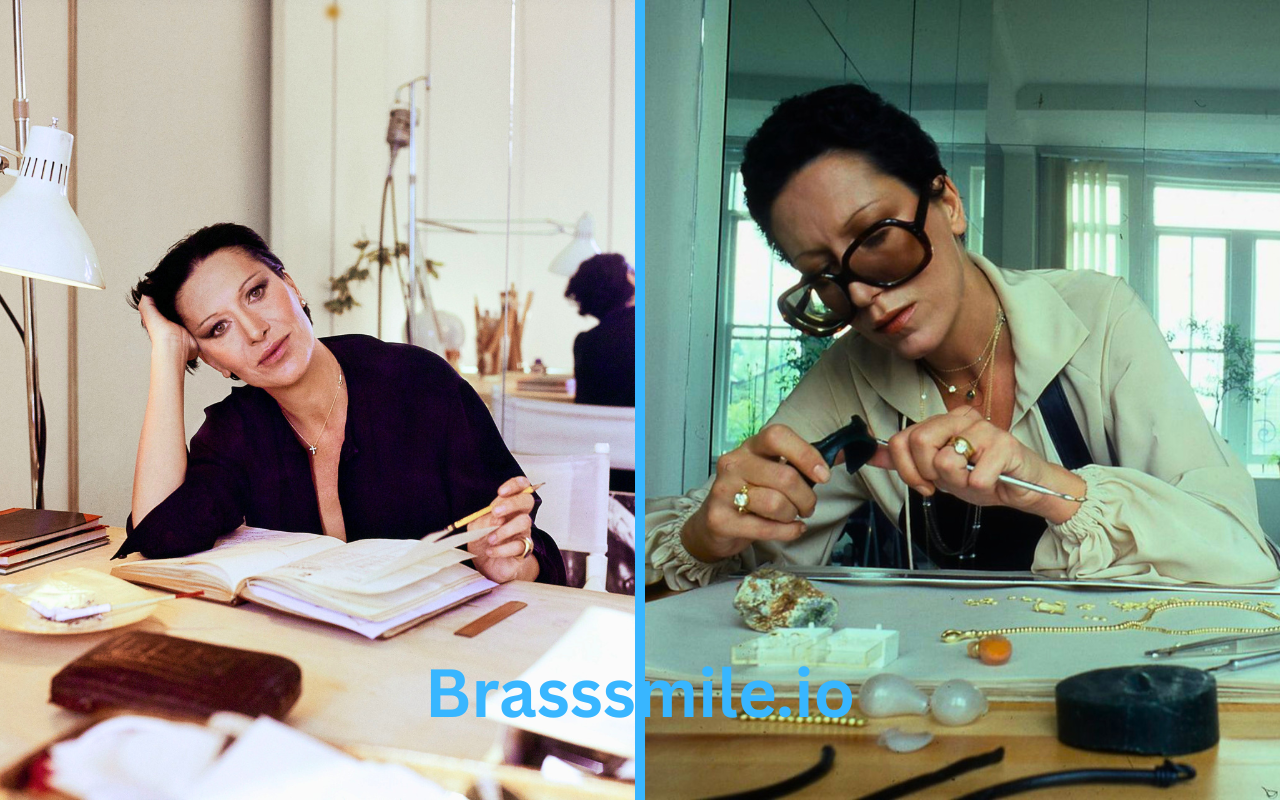
Elsa Peretti: The Rebel Who Revolutionized Jewelry Design
Elsa Peretti didn’t just design jewelry; she fundamentally changed how the world perceives it. Before she arrived at Tiffany & Co. in 1974, silver was considered an inferior metal, diamonds were reserved for formal occasions, and jewelry was something women received as gifts rather than bought for themselves. Peretti upended all of that, transforming silver into a luxury item and creating pieces that became modern talismans of empowerment . Her designs—the sculptural Bone Cuff, the sensuous Open Heart pendant, and the delicate Diamonds by the Yard—redefined modern adornment. Even today, nearly all of her original collections remain in continuous production, a testament to their timeless appeal. This is the story of a visionary who refused to follow the rules, built an empire through sheer creativity, and left an indelible mark on the world of fashion and jewelry design.
Table of Contents
ToggleQuick Facts
| Attribute | Details |
|---|---|
| Full Name | Elsa Peretti |
| Date of Birth | May 1, 1940 |
| Place of Birth | Florence, Italy |
| Date of Death | March 18, 2021 (age 80) |
| Nationality | Italian |
| Profession | Jewelry Designer, Fashion Model, Philanthropist |
| Known For | Iconic Tiffany & Co. collections, elevating sterling silver to luxury status |
| Parents | Ferdinando Peretti (father), Maria Luisa Pighini (mother) |
| Education | Educated in Rome and Switzerland; earned an interior design degree in Rome |
| Net Worth | $1 Million (at time of death in 2021) |
| Social Media | None (passed away in 2021) |
| Legacy | A pioneer of 20th-century jewelry design; works in the British Museum, The Met |
A Rebellious Beginning
Born into immense privilege in Florence, Italy, in 1940, Elsa Peretti was the daughter of Ferdinando Peretti, the founder of Anonima Petroli Italiana (API), a major oil company . She grew up in a conservative household, but her spirit was anything but conventional. Education took her to schools in Rome and Switzerland, and she initially worked as a ski instructor in the chic Swiss resort of Gstaad, and even taught French for a time . She later returned to Rome to study interior design, a field that honed her eye for form and space, which would later translate perfectly into her sculptural jewelry . However, the restrictions of her family’s traditional expectations proved too suffocating. Peretti rebelled, and in doing so, she was cut off from the family’s wealth. This was a pivotal moment—one that forced her to carve her own path. It also marked the beginning of a decade of transformation that would define a generation .
In 1964, Peretti began modeling in Barcelona, Spain. By 1968, she had moved to New York City, quickly joining the elite Wilhelmina Modeling Agency . Her look was striking and unconventional: tall, dark, and skinny with a pixie haircut that contrasted sharply with the “blonde and blue-eyed” ideal of the era . She became part of Halston’s famous troupe of models known as the “Halstonettes,” a glamorous group that also included Anjelica Huston and Pat Cleveland . While modeling, Peretti was always creating on the side, experimenting with jewelry designs . “The others were clothes racks… But Elsa had style: She made the dress she was modeling her own,” Halston once said of her . It was through modeling for Giorgio di Sant’Angelo that her first major design—a silver bud vase on a leather thong inspired by a flea market find—caught the world’s attention in 1969 . It was an instant hit, and the world of jewelry would never be the same.
The Revolution at Tiffany & Co.
By 1974, Peretti had already received a Coty Award for her jewelry design and had opened a boutique at Bloomingdale’s, a major department store . But her career reached a whole new stratosphere when she signed an exclusive contract with Tiffany & Co. . The house had not sold silver in 25 years, considering it a pedestrian metal. Peretti’s bold, modern designs changed everything. On the day her first Tiffany collection debuted, it sold out . She was on her way to becoming what Vogue would later call “arguably the most successful woman ever to work in the jewelry field” .
Her pieces were revolutionary for their time. The Bone Cuff, introduced in 1970, was inspired by the skeletons of monks she saw as a child in a Capuchin church . Its fluid form hugs the wrist, merging the body and the ornament. The Open Heart collection, featuring an off-center heart, showcased the influence of modern sculptors like Alexander Calder and Henry Moore . The Diamonds by the Yard collection was another radical idea: a simple, fine chain with a diamond bezel-set at intervals, designed to be worn every day rather than just for special occasions . “I want something easy,” Peretti once said, and her designs embodied that ethos of effortless chic . These weren’t just pieces of jewelry; they were statements of independence and modern style that resonated powerfully with women of the time, and they remain classics to this day . At one point, her designs accounted for as much as 10% of Tiffany’s business .
Legacy of a Lifetime
Over a career spanning more than 50 years with Tiffany & Co., Peretti created over 30 collections . Her aesthetic vocabulary expanded beyond jewelry to include sterling silver home goods, pens, and even the bottle for Halston’s signature fragrance . Her work is held in the permanent collections of major museums, including the British Museum, the Metropolitan Museum of Art, and the Museum of Fine Arts in Boston . In 2013, Tiffany renewed her contract for a stunning $47 million, a clear indicator of her enduring value and influence .
Beyond her commercial success, Peretti was a passionate philanthropist. In 2000, she founded the Nando Peretti Foundation (later renamed the Nando and Elsa Peretti Foundation) in honor of her father, with whom she had reconciled before his death . The foundation has donated approximately €50 million to over a thousand projects across the globe, focusing on human rights, education, and environmental conservation . She also dedicated enormous personal resources to restoring the historic village of Sant Martí Vell in Catalonia, Spain, where she lived for most of her later life . By the 1980s, the centuries-old village had become her sanctuary and a testament to her belief in preserving beauty and heritage .
The Quiet Life of an Icon
In her personal life, Peretti was known for her fierce independence. She had a romantic relationship with photographer Helmut Newton in the 1970s but remained unmarried and fiercely private . In the 1980s, she largely withdrew from the New York social scene, preferring the quiet peace of Sant Martí Vell . She once said she was not interested in the glitz of the jewelry world, but in the feeling a piece brings. “I always focus on the operating mechanism and the feeling that the product brings. Each piece of jewellery must be both beautiful to attract and comfortable to wear,” she reflected . This tactile, almost spiritual approach to design is what made her work so resonant.
Her Net Worth and Enduring Influence
Elsa Peretti’s net worth at the time of her death was estimated to be around $1 million . It’s important to note that while this might seem modest for a designer of her stature, the specifics of her wealth were private, and the $47 million contract with Tiffany in 2013 was a major payday . Her income largely came from her royalties and design contracts with the luxury house . Her designs remain a bestseller for Tiffany, ensuring her legacy continues to generate revenue .
Elsa Peretti passed away peacefully in her sleep at her home in Spain on March 18, 2021, at the age of 80 . Yet her legacy is evergreen. In 2024, Tiffany & Co. celebrated the 50th anniversary of her collaboration with the brand, releasing new iterations of her iconic designs, including the new Split Ring inspired by her Bone Cuff . As Anthony Ledru, President and CEO of Tiffany & Co., stated, “Elsa Peretti’s 50th anniversary at Tiffany & Co. is a remarkable testament to the House’s heritage of collaborating with the world’s greatest artists” . She remains a muse and a master, a true iconoclast who defied convention and, in doing so, created a universe of beauty that will be cherished for generations. As Elsa Peretti continues to inspire future generations of designers, her story stands as a reminder of how resilience, vision, and passion can shape a truly meaningful legacy.
Read this to: Bill O’Reilly Net Worth: A Deep Dive into the Life, Career, and Fortune of the ‘No Spin’ Commentator
Frequently Asked Questions (FAQs)
1. Who was Elsa Peretti?
Elsa Peretti was an Italian jewelry designer and former fashion model, best known for her iconic designs for Tiffany & Co. She revolutionized the jewelry industry by elevating sterling silver to a luxury status and creating timeless pieces like the Bone Cuff, Open Heart, and Diamonds by the Yard .
2. What is Elsa Peretti most famous for?
She is most famous for her minimalist, sculptural designs, particularly the Bone Cuff bracelet, the Open Heart pendant, and the Diamonds by the Yard necklace. Her work is credited with bringing a modern, sensual, and independent spirit to fine jewelry .
3. Did Elsa Peretti come from a wealthy family?
Yes, she was the daughter of Ferdinando Peretti, the founder of API, a large Italian oil company. However, she was estranged from her family for a period and was cut off from their wealth, forcing her to succeed on her own merits .
4. How did Elsa Peretti change Tiffany & Co.?
Before Peretti, Tiffany’s had not sold silver in 25 years. Her collection was so successful on its first day that it completely sold out. She brought a younger, more fashion-forward clientele to the brand and her designs came to represent up to 10% of the company’s business .
5. Was Elsa Peretti married?
No, Elsa Peretti was not married. She was romantically involved with photographer Helmut Newton for a time in the 1970s .
6. What was Elsa Peretti’s net worth?
Elsa Peretti’s net worth was estimated to be around $1 million at the time of her death in 2021 .
7. Does Tiffany & Co. still sell Elsa Peretti designs?
Yes, absolutely. All of Peretti’s main collections remain in production and are bestsellers for the house. In 2024, the brand even celebrated the 50th anniversary of her designs with special new creations .
8. Is Elsa Peretti mentioned in the Netflix series Halston?
Yes, she is a central character in the Netflix series Halston, portrayed by actress Rebecca Dayan. The series explores her friendship with the legendary designer and her life during the glamorous 1970s .