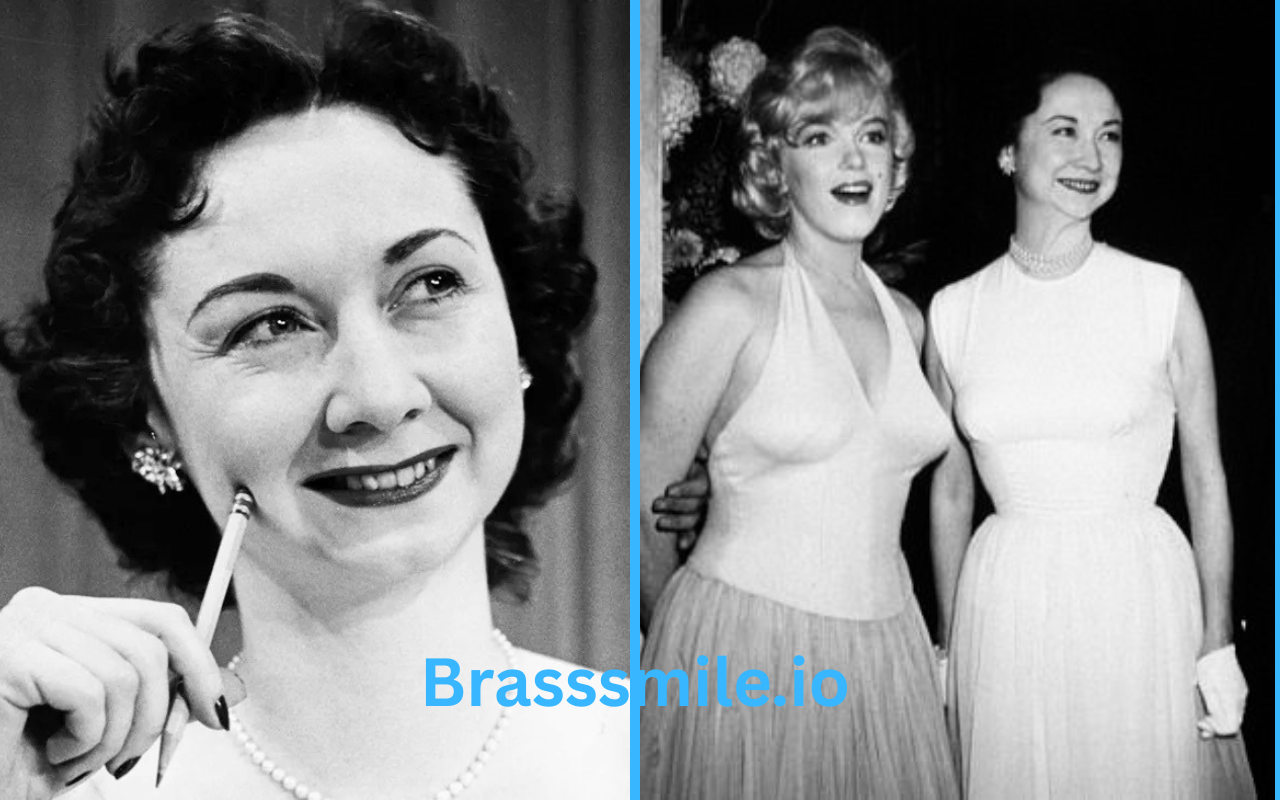
Dorothy Kilgallen: The Trailblazing Journalist Who Knew Too Much
She was the most famous female journalist of her era — a woman who could crack a joke with celebrities on Sunday night television, then fly to Dallas to interrogate a presidential assassin the very next day. Dorothy Kilgallen moved through the worlds of Broadway glamour and hard-hitting investigative journalism with equal ease, becoming a household name at a time when women in newsrooms were still largely confined to writing about fashion and society weddings. Her syndicated column reached an estimated twenty million readers , her face was recognized from coast to coast, and her byline commanded respect in the most competitive newsrooms in America. Yet for all her fame and success, Kilgallen’s life ended in tragedy and mystery — a death that has fueled speculation, conspiracy theories, and unanswered questions for more than half a century. This is the story of a woman who broke every rule, shattered every glass ceiling, and may have paid the ultimate price for knowing too much.
Table of Contents
ToggleQuick Facts About Dorothy Kilgallen
| Category | Details |
|---|---|
| Full Name | Dorothy Mae Kilgallen |
| Born | July 3, 1913 — Chicago, Illinois, U.S. |
| Died | November 8, 1965 — Manhattan, New York, U.S. (aged 52) |
| Resting Place | Gate of Heaven Cemetery |
| Profession | Journalist, Columnist, Television Panelist, Author, Radio Host |
| Parents | James Lawrence Kilgallen (journalist) and Mae Jane Ahern (singer) |
| Siblings | Eleanor Kilgallen (younger sister) |
| Education | Erasmus Hall High School, Brooklyn; College of New Rochelle (two semesters) |
| Spouse | Richard Kollmar (married April 6, 1940) |
| Children | Three: Richard “Dickie” Jr., Jill-Ellen, and Kerry |
| Notable Work | “The Voice of Broadway” column (syndicated in 140+ papers); Panelist on What’s My Line?; Girl Around the World (book) |
| Net Worth | Estimated $1–5 million (at time of death, adjusted for inflation) |
| Social Media | N/A (pre-digital era) |
Early Life and Formative Years
Dorothy Mae Kilgallen entered the world on July 3, 1913, in Chicago, Illinois, born into a family where ink and newsprint ran through the veins . Her father, James Lawrence Kilgallen, was a highly respected journalist who worked for the Hearst Corporation’s International News Service . Her mother, Mae Jane Ahern, was a singer with a promising career before marriage . Journalism, it seemed, was destiny for young Dorothy — but the path to that destiny would require her to navigate a world that didn’t always welcome women with ambition.
The Kilgallen family moved frequently during Dorothy’s childhood, following her father’s career from Chicago to Laramie, Wyoming, then to Indianapolis and back to Chicago again . In 1920, when Dorothy was seven years old, the International News Service hired James Kilgallen as a roving correspondent based in New York City, and the family finally settled in Brooklyn . This rootless childhood, moving from city to city, may have shaped Dorothy’s adaptability and fearlessness — qualities that would serve her well in her future career.
Dorothy attended public schools and graduated from Erasmus Hall High School in Brooklyn in 1930 . She was a good student and, according to those who knew her, a voracious reader who consumed books and newspapers with an appetite that hinted at her future profession . After high school, she enrolled at the College of New Rochelle, a Catholic women’s college in New York, with the intention of earning a degree .
But Dorothy Kilgallen was not destined to spend four years in a classroom. The newsroom was calling, and she was eager to answer.
Breaking Into Journalism
In 1931, just shy of her eighteenth birthday, Kilgallen accepted a summer job as a cub reporter for the Hearst Corporation’s New York Evening Journal . She never returned to college. The world of journalism in the early 1930s was a tough, male-dominated arena. Although the number of female reporters had roughly doubled between 1920 and 1930, most women were still relegated to writing for the society pages or the “women’s interest” sections . Male editors often treated female reporters as novelties, and the pejorative labels “sob sisters” and “stunt girls” were frequently applied to women who dared to compete with their male counterparts .
But Kilgallen was different. She had something that couldn’t be taught in any journalism school: raw talent, relentless drive, and the kind of steel ambition that her colleague James “Red” Horan later described as hiding beneath her “soft, quiet way” . She quickly earned bylines for clever, sentimental stories about hospitalized children, and before long, she was assigned to the morgue beat — covering ferryboat explosions, marriage mills, murders, trials, and executions .
She threw herself into the work with astonishing energy. During a five-week murder trial in Salem, Massachusetts, in 1933, the young reporter produced an incredible 250,000 words of copy . Two years later, she covered the trial of Bruno Hauptmann in Flemington, New Jersey — the sensational case of the man convicted of kidnapping and murdering the infant son of aviator Charles Lindbergh . It was grueling, high-pressure work, and Kilgallen handled it with a professionalism that earned her the respect of her peers and superiors alike.
Her career was just beginning, but Dorothy Kilgallen was already proving that she was not just a “woman reporter” — she was simply a damn good reporter.
The Race Around the World
In 1936, the Hearst Corporation devised a publicity stunt that would change Kilgallen’s life forever. The newspaper entered her in a race against two rival reporters — Leo Kieran of The New York Times and Bud Ekins of United Press International — to see who could travel around the world the fastest using only commercial means of transportation .
Kilgallen was the only woman in the competition, and she embraced the challenge with characteristic gusto. She traveled by ship, train, airplane, and any other mode of transport available, cabling back dispatches that captivated readers with their vivid detail and wry humor. In Calcutta, she described her taxi as it “wheezed and coughed” on its way to the airport; flying over the jungles of Indochina, she joked about her fear that “tigers and great constrictor snakes lie in wait for little girls” .
Kilgallen completed the journey in twenty-four days, twelve hours, and fifty-two minutes — losing by almost six days to the winner but winning something far more valuable: national fame . She was a celebrity, and the Hearst Corporation knew exactly what to do with her. She turned her dispatches into a book, Girl Around the World (1937), which became a popular success . She collaborated on the screenplay for the 1937 movie Fly Away Baby, loosely based on her globe-trotting adventure, and even took a bit part as a reporter in the film Sinner Take All .
She was still in her early twenties, and she had already achieved more than most journalists accomplish in a lifetime.
The Voice of Broadway
In 1938, Kilgallen took over a syndicated column for her newspaper — now called the New York Journal-American — called “The Voice of Broadway” . The column would become her signature, a daily blend of show-business gossip, political commentary, crime reporting, and sharp-witted observations about the rich and famous. It was syndicated to more than 140 newspapers across the United States and beyond, making Kilgallen one of the most widely read columnists in the country .
“The Voice of Broadway” was a phenomenon. Kilgallen had an uncanny ability to get inside information about celebrities, politicians, and organized crime figures alike . She cultivated sources in every corner of New York society, from Broadway dressing rooms to police precincts to the back rooms of nightclubs. Her columns were read not just by ordinary citizens but by the powerful and famous themselves, who both feared and courted her attention.
She covered the coronation of King George VI in London in 1937, Franklin D. Roosevelt’s first presidential campaign, and Harry S. Truman’s nomination for the presidency . She reported on organized crime with a fearlessness that put her in dangerous circles, and she never shied away from taking on powerful figures when she believed they were in the wrong.
By 1950, it was estimated that Kilgallen had twenty million readers . She was one of the most influential journalists in America, and she wielded that influence with a combination of charm, wit, and an unshakeable commitment to the truth as she saw it.
Television Stardom
In 1950, Kilgallen joined the panel of a new CBS television game show called What’s My Line? . The show, hosted by John Charles Daly, featured a panel of celebrities who would ask yes-or-no questions to guess the occupations of mystery guests. Kilgallen joined fellow regular panelists Arlene Francis and Bennett Cerf, and the trio became one of the most beloved ensembles in television history .
What’s My Line? was a massive hit. It won three Emmy Awards for Best Quiz or Audience Participation Show (in 1952, 1955, and 1958) and a Golden Globe Award for Best TV Show in 1962 . Kilgallen became a familiar face in millions of American living rooms, her quick wit and sharp intelligence on full display every Sunday night. She took the game seriously but never failed to inject humor into each telecast, and her chemistry with Francis and Cerf was a key ingredient in the show’s enduring appeal .
The television exposure made Kilgallen even more famous, and she used her platform to further her journalism career. She was photographed with celebrities like Frank Sinatra, Rock Hudson, and George Harrison , and her autograph was sought after wherever she went. At one point, a request for her autograph from a judge in a murder trial would lead to one of the most significant moments of her career — and to justice being served.
The Sam Sheppard Case
In 1954, Kilgallen covered the trial of Dr. Sam Sheppard, an Ohio physician accused of brutally murdering his pregnant wife, Marilyn . The case was a media sensation, and Kilgallen was in the courtroom, reporting on every twist and turn. She expressed shock in her column when Sheppard was convicted, believing that the evidence against him was flimsy and that he had not received a fair trial .
Years later, Kilgallen revealed a stunning piece of information to a group of fellow reporters. During the trial, she had encountered the judge, Edward Blythin, who asked for her autograph. In the course of their conversation, the judge told her, “It’s an open-and-shut case… he is guilty as hell” . This was a clear violation of judicial ethics — a judge expressing an opinion on a defendant’s guilt before the trial had concluded.
Kilgallen’s testimony about this encounter became crucial when Sheppard’s attorney, F. Lee Bailey, appealed the conviction . The revelation that the judge had prejudged the case helped overturn Sheppard’s conviction, and he was ultimately acquitted in a retrial. It was a powerful example of Kilgallen’s influence — and of her willingness to speak truth to power, even when it meant exposing a judge’s misconduct.
Radio and Family Life
In 1940, Kilgallen married Richard Kollmar, a musical comedy actor and singer who had starred in Broadway productions like Knickerbocker Holiday and Too Many Girls . The couple had three children: Richard “Dickie” Jr. (born 1941), Jill-Ellen, and Kerry . Unlike many professional women of her era, Kilgallen did not choose between career and family — she pursued both with equal determination.
From 1945 to 1963, Kilgallen and Kollmar hosted a morning radio show called Breakfast with Dorothy and Dick . The show was a natural extension of their public personas, blending conversation, celebrity interviews, and the kind of easy banter that made listeners feel like they were part of the family. It was yet another platform for Kilgallen to connect with her audience and build her brand.
The marriage was not without its challenges. Kollmar’s career never quite reached the heights of his wife’s, and there were rumors of tension and infidelity on both sides. But they remained married until Kilgallen’s death, and together they raised three children in a townhouse on Manhattan’s Upper East Side.
The JFK Investigation
In November 1963, President John F. Kennedy was assassinated in Dallas, Texas. Like millions of Americans, Dorothy Kilgallen was stunned by the tragedy. But unlike most Americans, she had the resources, connections, and determination to investigate what really happened.
Kilgallen jumped at the chance to cover the trial of Jack Ruby, the Dallas nightclub owner who shot and killed Lee Harvey Oswald — the man accused of assassinating Kennedy — in the basement of a Dallas police station . She traveled to Dallas and sat in the courtroom, watching Ruby’s trial unfold and taking meticulous notes .
What she discovered there troubled her deeply. She became convinced that the official story — that Oswald had acted alone — was incomplete at best and a cover-up at worst. She began an 18-month investigation into the assassination, digging into the connections between organized crime, intelligence agencies, and the Kennedy administration .
Kilgallen’s investigation led her to suspect that New Orleans Mafia boss Carlos Marcello had masterminded the assassination . She believed that Marcello had orchestrated the killings of both Kennedy and Oswald, and she was preparing to publish a tell-all book that would expose the truth .
The book was never published. On November 8, 1965, Dorothy Kilgallen was found dead in her Manhattan townhouse . She was 52 years old.
The Mysterious Death
The official cause of Kilgallen’s death was ruled as an accidental overdose — a toxic mix of alcohol and barbiturates . But from the very beginning, there were questions. Kilgallen was found in her bed, still wearing makeup, with a book resting on her chest . Her notes from the JFK investigation — a dossier she had been compiling for 18 months — had vanished without a trace .
The circumstances of her death were suspicious. There was no autopsy, no thorough investigation, and the scene was quickly cleaned up . Kilgallen’s family, friends, and colleagues were left with more questions than answers. Over the years, theories have abounded: Was she murdered to prevent her from publishing her findings? Was she killed by the Mafia? By the FBI? By someone else entirely?
Author Mark Shaw has written extensively about Kilgallen’s death in books like The Reporter Who Knew Too Much and Denial of Justice, arguing that she was the victim of foul play orchestrated by Carlos Marcello . In 2017, the Manhattan District Attorney’s office announced that it was looking into Kilgallen’s death, though no charges have ever been filed .
The mystery of Dorothy Kilgallen’s death remains unsolved. But her legacy as one of the most fearless and accomplished journalists in American history is beyond question.
Legacy and Recognition
Dorothy Kilgallen received a star on the Hollywood Walk of Fame in 1960 as one of the initial 500 honorees . She was nominated for a Pulitzer Prize for her work, though she never won . More importantly, she inspired generations of women journalists who followed in her footsteps, proving that a woman could compete — and excel — in the toughest newsrooms in the country.
Her story has been the subject of books, documentaries, and an upcoming feature film starring Jessica Chastain, which will bring her remarkable life and mysterious death to a new generation of viewers .
Conclusion: A Legacy of Courage
Dorothy Kilgallen was many things: a trailblazing journalist, a beloved television personality, a devoted mother, and a fearless investigator who refused to back down in the face of powerful forces. She lived her life on her own terms, breaking rules and shattering expectations at every turn. And she died under circumstances that remain one of journalism’s greatest mysteries.
Her story is a reminder that the truth is worth pursuing, even when it’s dangerous. It’s a testament to the power of perseverance, the importance of asking hard questions, and the courage it takes to speak truth to power. Dorothy Kilgallen may have been silenced, but her legacy lives on — in the journalists who continue to investigate, in the readers who still seek the truth, and in the example she set for generations of women who refuse to be confined by society’s expectations.
As Dorothy Kilgallen’s story continues to captivate new audiences, her journey stands as a powerful reminder of how resilience, integrity, and an unwavering commitment to the truth can shape a legacy that endures long after we’re gone.
Read this to: Selena Quintanilla Net Worth: The Queen of Tejano’s Enduring Financial Legacy
Frequently Asked Questions
1. Who was Dorothy Kilgallen?
Dorothy Kilgallen was a pioneering American journalist, newspaper columnist, and television panelist. She wrote the syndicated column “The Voice of Broadway,” appeared as a regular panelist on the CBS game show What’s My Line?, and conducted an extensive investigation into the assassination of President John F. Kennedy.
2. How did Dorothy Kilgallen die?
Dorothy Kilgallen was found dead in her Manhattan townhouse on November 8, 1965. The official cause of death was ruled an accidental overdose of alcohol and barbiturates. However, many believe her death was suspicious, and conspiracy theories have persisted for decades suggesting she was murdered because of her JFK assassination investigation.
3. What was Dorothy Kilgallen’s net worth?
At the time of her death in 1965, Kilgallen’s net worth was estimated to be between $1 million and $5 million, largely from her syndicated column, television appearances, and radio show. Adjusted for inflation, this would be significantly more today.
4. Was Dorothy Kilgallen married?
Yes, Kilgallen married actor and singer Richard Kollmar on April 6, 1940. They remained married until her death in 1965 and had three children together.
5. Did Dorothy Kilgallen have children?
Yes, Kilgallen had three children: Richard “Dickie” Kollmar Jr. (born 1941), Jill-Ellen Kollmar, and Kerry Kollmar.
6. What was Dorothy Kilgallen’s column called?
Kilgallen’s syndicated newspaper column was called “The Voice of Broadway.” It ran from 1938 until her death in 1965 and was published in more than 140 newspapers across the United States.
7. Was Dorothy Kilgallen on What’s My Line?
Yes, Kilgallen was a regular panelist on What’s My Line? from 1950 until her death in 1965. She appeared alongside Arlene Francis and Bennett Cerf, and the show was one of the most popular television programs of its era.
8. Did Dorothy Kilgallen investigate the JFK assassination?
Yes, Kilgallen conducted an extensive 18-month investigation into the assassination of President John F. Kennedy. She covered the trial of Jack Ruby in Dallas and became convinced that there was a conspiracy behind the assassination.
9. Where is Dorothy Kilgallen buried?
Dorothy Kilgallen is buried at Gate of Heaven Cemetery in Hawthorne, New York.
10. Does Dorothy Kilgallen have a star on the Hollywood Walk of Fame?
Yes, Kilgallen received a star on the Hollywood Walk of Fame in 1960 as one of the initial 500 honorees.
11. Was Dorothy Kilgallen the first female crime reporter?
While she wasn’t the very first, Kilgallen was one of the most prominent female crime reporters of her era. She broke significant ground for women in journalism and covered some of the most sensational trials of the 20th century.
12. What books have been written about Dorothy Kilgallen?
Several books have been written about Kilgallen, including The Reporter Who Knew Too Much by Mark Shaw, Denial of Justice by Mark Shaw, and Kilgallen by Lee Israel. These books explore her life, career, and the mystery surrounding her death.